JobHunt Agent: Agentic Job Discovery and LLM Triage
A self-hosted agentic workflow that tracks about 6,300 open roles from 27 sources, ranks them with calibrated LLM scoring and deterministic rules, and leaves every action to a human.
Context
I built this for my own job search. The roles worth applying to are spread across company ATS boards, remote job feeds, Hacker News threads and India startup directories. They’re listed in a dozen currencies, and the best ones close within days. Keyword alerts miss good roles and bury the rest in noise.
Problem
- Volume: thousands of open roles, most of them irrelevant.
- Normalization: pay comes as hourly, monthly or yearly figures in many currencies, and locations come as free text (“Remote, India or Bangalore hybrid”).
- Judgement: deciding whether a role actually fits needs reading the job description, which is where an LLM helps. Everything else has to be exact and auditable, which is where an LLM hurts.
- Cost and reliability: it runs on a laptop that sleeps, on a budget of a few dollars a month.
What I Built
- Ingestion from 27 sources through official job-board APIs, feeds and public pages, polite by design: robots.txt, per-host rate limits and a host denylist.
- A LangGraph pipeline where deterministic code handles deduplication, location, pay and currency conversion. Two narrow LLM steps judge relevance and fit, and both return schema-validated output.
- Fit scoring with must-have requirements enforced in code, so the model can’t over-rate a role that misses a hard requirement.
- Labels, not filters. Nothing is hidden automatically. Misfits are marked and ranked lower, and only I dismiss.
- A Slack board and a web tracker with two-way sync, so triage works from a phone.
- Cost and reliability controls: a per-call cost ledger, daily and per-provider budget caps, provider fallback, a failure ledger with replay, sampled tracing, and a scheduler that catches up on whatever was missed while the laptop slept.
Architecture
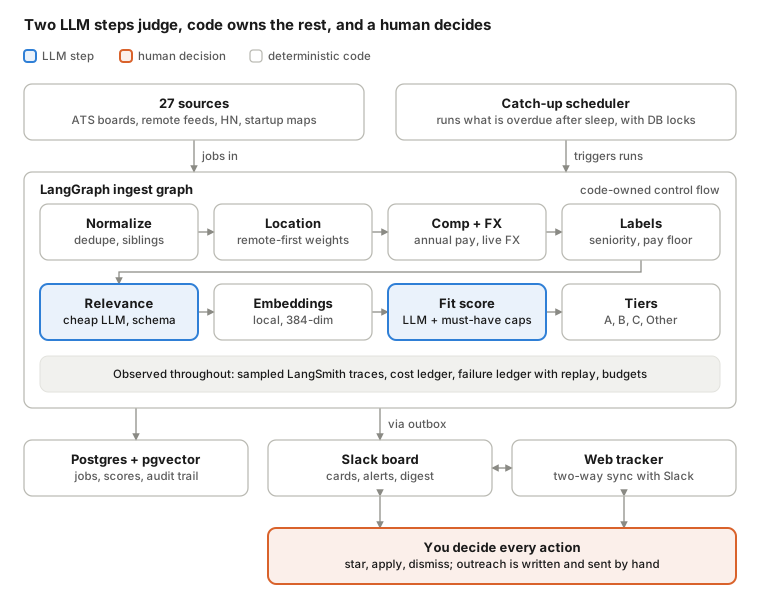
Jobs flow top to bottom. The model judges only relevance and fit; every other step is tested code. Ranking blends the fit score with location and similarity to my profile, with remote roles weighted first.
Stack
Python, FastAPI, LangGraph, PostgreSQL with pgvector, Claude and OpenAI models behind a router with fallback, local embeddings, LangSmith for tracing, Slack Bolt in Socket Mode, HTMX for the UI, Playwright for end-to-end tests.
Outcome
- About 6,300 open roles tracked, and about 1,900 scored for roughly $2 of model spend.
- Around 90 Tier A and 190 Tier B leads surfaced, each with plain-language reasons.
- The model was chosen by measurement: in a calibration study, the cheaper model matched the stronger model’s top 10 after must-have gating, at about 1/20th of the cost.
- 426 automated tests and 33 browser end-to-end tests covering every UI control.
- Next: an evaluation harness built from my own accept and dismiss decisions, so every prompt or model change has to pass a quality bar before it ships.